Key takeaways
- Landed cost = product price + inland and ocean freight + insurance + import duties + port and brokerage fees + delivery; installation and recoverable VAT/GST are tracked separately.
- Ocean freight for one 40HQ holding about 180 m² usually adds only USD 6–17 per m² of windows, so freight is rarely more than 5–8% of landed cost.
- Cargo insurance is normally calculated on 110% of the CIF value at a premium of roughly 0.1–0.5%, which is small compared with the cost of an uninsured broken pane.
- Anti-dumping and countervailing duties on Chinese aluminium extrusions exist in the USA, EU and Australia; whether finished windows are in scope is fact-specific, so obtain a binding ruling or broker advice before ordering.
- In the worked example below, an FOB price of USD 220/m² becomes about USD 262/m² landed before VAT and about USD 322/m² installed, excluding any anti-dumping duty.
The landed cost of imported windows is the total cost to get them to your site, cleared and ready to install: the factory price plus freight, insurance, import duties, port charges, brokerage and delivery. For aluminium windows from China, the factory price is typically 75–85% of landed cost, but the remaining 15–25% — and the risk of anti-dumping duty — decides whether the import is actually cheaper than buying locally.
This guide breaks the calculation into its components, works through one 40HQ container of lift-and-slide doors with clearly labelled assumptions, and lists what changes by country. Use it to build your own model, then have a licensed customs broker confirm duty and tax for your specific product.
The landed-cost formula
- Product price at the agreed Incoterm — EXW (factory gate) or, more commonly, FOB (loaded on the vessel at the Chinese port).
- Inland China costs if you buy EXW: trucking to port, export customs and terminal handling, typically USD 300–700 per container.
- Ocean freight per container, converted to cost per m².
- Cargo insurance, usually on 110% of CIF value.
- Import duty on the customs value (CIF in the EU, UK and many other countries; broadly FOB-based transaction value in the USA and Australia).
- Anti-dumping or countervailing duty, if the product falls within the scope of an order.
- VAT, GST or sales tax, often recoverable for registered businesses.
- Destination port, brokerage and delivery: terminal handling, documentation, customs entry, haulage and unloading.
- Installation, which belongs in project cost, not landed cost, but must be in your comparison with local suppliers.
Freight and insurance per square metre
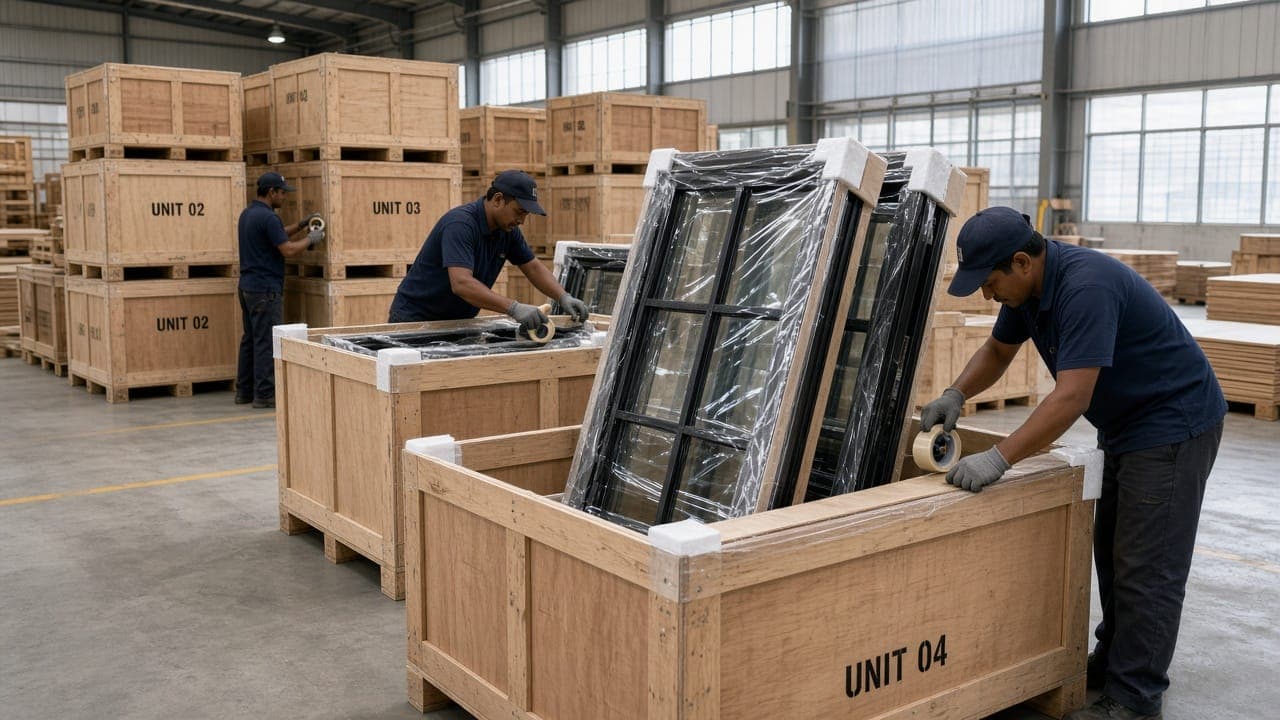
A 40HQ container typically carries about 180 m² of crated windows and doors. Spread over that area, ocean freight is a modest line item: ARCVIEW's estimator uses USD 6–17 per m² depending on region, from short Asian routes to West Africa. Freight rates are volatile, so ask for a dated quote and a validity period. Cargo insurance on Institute Cargo Clauses (A) is typically quoted at 0.1–0.5% of 110% of the CIF value; see our Incoterms guide for who buys it under each term.
Worked example: 180 m² of lift-and-slide doors in one 40HQ
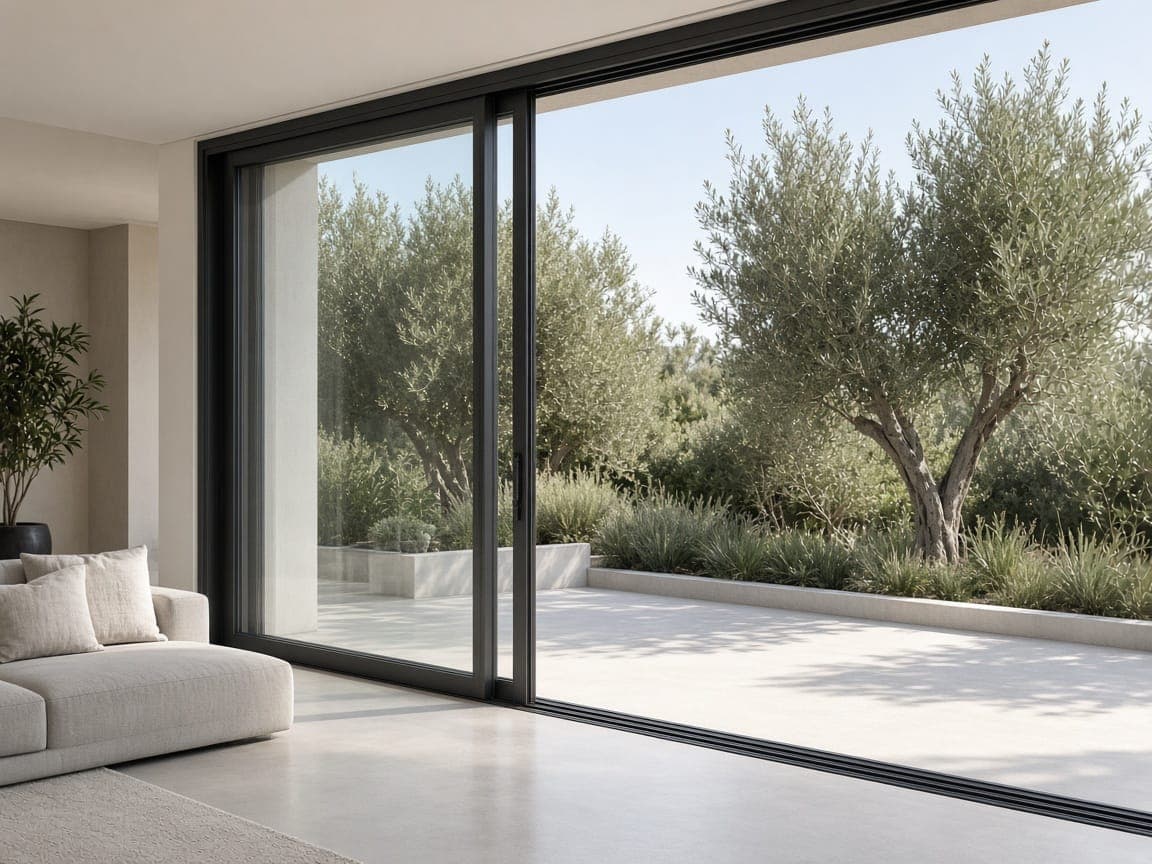
The following example uses assumed rates for a generic destination. They are not quotes and not the duty rates of any specific country. The product price sits inside ARCVIEW's published range of USD 180–260 per m² for lift-and-slide doors.
| Line item | Assumption | USD total | USD per m² |
|---|---|---|---|
| Product price, FOB Chinese port | 180 m² × USD 220/m² | 39,600 | 220.0 |
| Inland China and export handling | Included in FOB price | 0 | 0.0 |
| Ocean freight, 40HQ | Assumed USD 2,700 per container | 2,700 | 15.0 |
| Cargo insurance | 0.3% × 110% of CFR value (USD 42,300) | 140 | 0.8 |
| CIF value | Sum of the rows above | 42,440 | 235.8 |
| Import duty | Assumed 6% of CIF (illustrative only) | 2,546 | 14.1 |
| Anti-dumping / countervailing duty | Not included — see section below | 0 | 0.0 |
| Destination port charges and brokerage | Assumed flat USD 1,200 | 1,200 | 6.7 |
| Delivery to site and unloading | Assumed USD 900, crane not included | 900 | 5.0 |
| Landed cost before VAT/GST | 47,086 | 261.6 | |
| VAT/GST | Assumed 20% of CIF + duty; recoverable if registered | 8,997 | 50.0 |
| Installation | Assumed USD 60/m² local labour | 10,800 | 60.0 |
| Installed cost before VAT/GST | 57,886 | 321.6 |
Two lessons stand out. First, freight and insurance add less than USD 16 per m², so choosing a slightly more expensive but better-engineered system rarely changes the business case. Second, the import duty line is the most uncertain: a trade-remedy duty on aluminium could exceed the entire freight cost several times over. On ARCVIEW's standard terms, this order would be paid as a 30% T/T deposit (USD 11,880) and a 70% balance (USD 27,720) against the B/L copy; an L/C is available for orders above USD 80,000.
Anti-dumping and countervailing duties on aluminium
Several jurisdictions apply trade-remedy duties to aluminium extrusions from China. The USA has had Department of Commerce anti-dumping and countervailing duty (AD/CVD) orders on aluminum extrusions from China since 2011 (cases A-570-967 and C-570-968). The European Union imposed definitive anti-dumping measures on aluminium extrusions from China in 2021. Australia's Anti-Dumping Commission administers measures on certain aluminium extrusions from China.
Whether a finished window or door is in scope is not automatic. In the US, Commerce has issued many scope rulings, and the so-called finished goods and finished goods kit exclusions depend on what is imported, how it is packed and whether it is ready for installation without further fabrication. Knock-down kits and loose profiles carry higher risk than fully assembled, glazed units. EU and Australian measures have their own product definitions and exemptions. Rates also vary by exporter and change with periodic reviews, which is why this article quotes none as current fact.
What varies by country
| Variable | What changes | Who confirms it |
|---|---|---|
| Customs valuation basis | CIF value (EU, UK, many others) vs FOB-based transaction value (USA, Australia) | Customs broker |
| Base import duty | Set by the national tariff for the HS code; may be reduced by trade agreements such as ChAFTA or RCEP with a valid certificate of origin | Customs broker / tariff database |
| Trade-remedy duties | AD/CVD scope and rates by exporter and product (notably USA, EU, Australia) | Broker, trade lawyer, binding ruling |
| VAT / GST / sales tax | Rate, collection point and whether it is recoverable | Tax adviser |
| Certification and pre-shipment schemes | e.g. SONCAP in Nigeria, SABER in Saudi Arabia, CE/UKCA in Europe | Approved certification bodies |
| Port and inspection fees | Terminal handling, quarantine checks on timber packing, demurrage risk | Freight forwarder |
| Transit time | 5–8 days to Manila up to 28–38 days to West Africa and Europe | Freight forwarder |
Our market pages for the USA, Australia and the UK summarise ports, transit times and certification paperwork. For a quick budget figure by system and region, use the estimator or the full landed-cost calculator, then replace its freight and duty assumptions with your broker's numbers.
Comparing landed cost with a local quote
Compare like for like: the same glass build-up, hardware brand, coating class and test performance. Add the cost of capital for paying 30% roughly 12–16 weeks before delivery, a contingency of 2–3% for breakage and site damage, and the cost of any local certification or engineering stamps. If the imported option is still cheaper after those additions and after a conservative trade-remedy scenario, the import is robust.
Frequently asked questions
- What is included in the landed cost of imported windows?
- Landed cost includes the product price, inland and export costs in China, ocean freight, cargo insurance, import duty, any anti-dumping or countervailing duty, destination port charges, customs brokerage and delivery to site. VAT or GST is often tracked separately because registered businesses can usually recover it. Installation is a project cost but should be included when comparing imported windows with a local supplier.
- How much does shipping add per square metre of windows?
- With about 180 m² of crated windows in a 40HQ container, ocean freight typically adds USD 6–17 per m², depending on route and market rates at the time of booking. Destination port charges, brokerage and delivery usually add another USD 8–15 per m². Together these are normally under 10% of landed cost for aluminium windows priced above USD 150 per m².
- Do anti-dumping duties apply to aluminium windows from China?
- They may. The USA, the EU and Australia have trade-remedy measures on aluminium extrusions from China, but whether finished windows and doors fall within scope depends on the specific order, product definition and how the goods are imported. US finished-goods exclusions are fact-specific. Obtain a binding ruling or written advice from a licensed customs broker or trade lawyer before ordering.
- Is import duty calculated on the FOB or CIF value?
- It depends on the country. The EU, UK and many other countries use the CIF value, including freight and insurance to the border. The USA and Australia use a transaction value that broadly excludes international freight and insurance. The difference is small on windows because freight is a low share of value, but a customs broker should confirm the basis for your entry.
- How do I reduce the landed cost of imported windows?
- Fill the container — around 180 m² per 40HQ — to spread fixed freight and port costs, use a valid certificate of origin where a trade agreement lowers duty, and avoid configurations with trade-remedy risk unless a ruling confirms their status. Ordering from the manufacturer rather than a trading company typically removes an 18–35% margin, which usually outweighs any freight saving.
Sources & standards
- 01Antidumping and countervailing duty proceedings — International Trade Administration, U.S. Department of Commerce
- 02Antidumping and countervailing duties and binding rulings — U.S. Customs and Border Protection
- 03Customs tariff, valuation and Binding Tariff Information — European Commission, DG Taxation and Customs Union
- 04Anti-Dumping Commission: measures and cases — Australian Government, Department of Industry, Science and Resources
- 05Customs valuation and Harmonized System — World Customs Organization
- 06Incoterms® 2020 rules — International Chamber of Commerce