Key takeaways
- Polyester powder coating at 60–80 μm is the lowest-cost finish with the widest colour range, and super-durable powders to Qualicoat Class 2 are sufficient for most residential and commercial windows.
- Anodising is the most UV-stable finish but has a limited colour range and practically cannot be touched up; specify AA20 or thicker for exterior work within about 5 km of the sea and AA25 for severe marine sites.
- PVDF to AAMA 2605 (10 years of South Florida exposure) is the benchmark for high-rise and landmark façades and typically costs 1.3–1.6 times as much as standard polyester powder.
- Qualicoat Class 1, 2 and 3 require 1, 3 and 10 years of Florida exposure; AAMA 2603, 2604 and 2605 require 1, 5 and 10 years, so Class 3 and AAMA 2605 are the closest equivalents.
- In coastal areas, finish warranties typically require fresh-water washing every 3–6 months; without it even the best coating can show filiform corrosion within a few years.
For most aluminium windows, a super-durable polyester powder coating to Qualicoat Class 2 (or AAMA 2604) offers the best balance of cost, colour choice and durability. Choose anodising for maximum UV stability and a metallic look, and PVDF to AAMA 2605 for high-rise façades and severe marine sites where a 10-year Florida-tested finish is required. The pre-treatment under the finish, and how often the frames are washed, matter as much on coastal projects as the finish itself.
How the three finishes differ
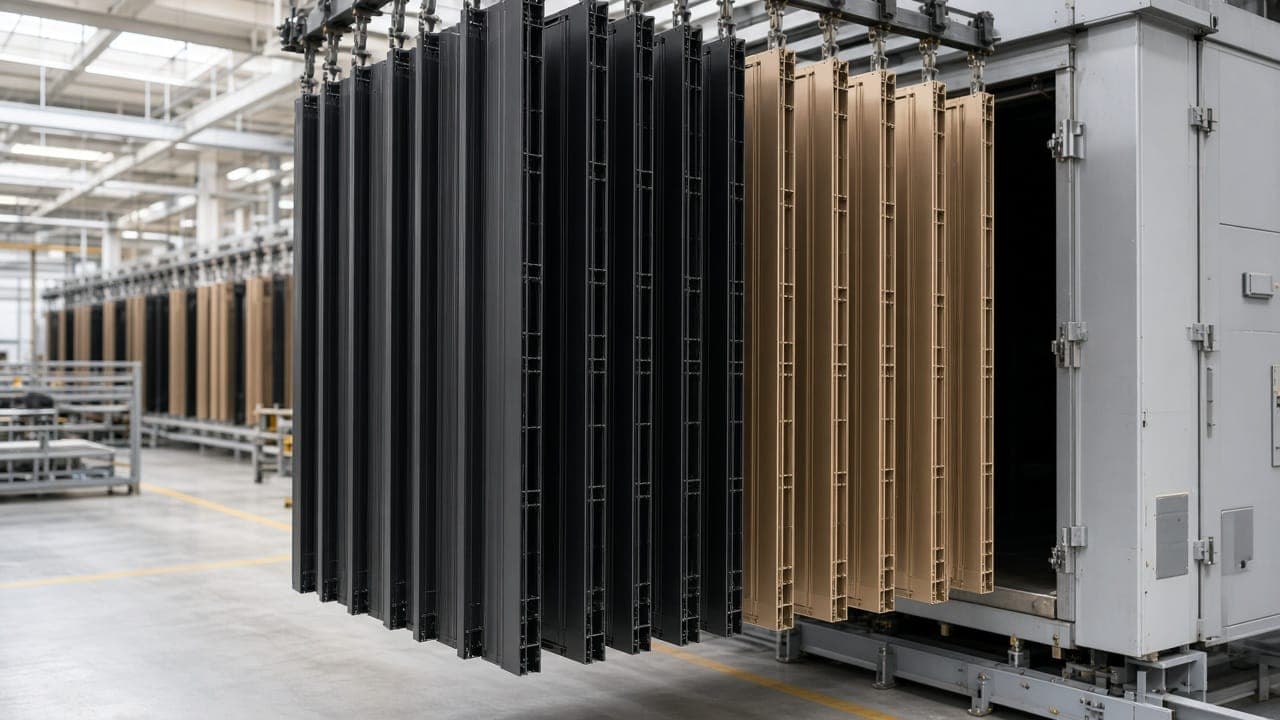
- Powder coating: dry polyester (or polyurethane, or PVDF-based) powder is applied electrostatically over a chemical conversion layer and cured at about 180–200 °C, typically to 60–80 μm.
- Anodising: an electrochemical process grows an aluminium oxide layer out of the metal itself. The layer is 15–25 μm thick for exterior grades and is coloured by electrolytic deposition or dye, then sealed. It is part of the metal rather than a coating on top.
- PVDF (liquid fluoropolymer): a two- or three-coat spray system of primer, colour coat and optional clear coat containing about 70% PVDF resin, typically 25–45 μm in total. It is common on North American and Asian curtain wall.
| Property | Polyester powder (standard / super-durable) | Anodising | PVDF liquid (2–3 coat) |
|---|---|---|---|
| Typical thickness | 60–80 μm | 15–25 μm oxide (AA15–AA25) | 25–45 μm |
| Colour range | Full RAL / NCS, textures, metallics, wood-grain | Clear, champagne, bronzes, black | Wide, including metallics and micas; few textures |
| UV and gloss retention | Standard: 1-year Florida; super-durable: 3 years or more | Excellent; colour is inorganic | Excellent; 10-year Florida (AAMA 2605) |
| Coastal suitability | Good with Seaside-type pre-treatment and washing | Good at AA20–AA25 with washing | Very good |
| Impact and abrasion | Good; can chip on sharp impact | Very hard surface; scratches are permanent | Good; softer than anodising |
| Site repair | Touch-up paint, close match | Practically not repairable | Air-dry fluoropolymer touch-up possible |
| Batch colour consistency | Very consistent | Natural shade variation; approve range samples | Very consistent |
| Relative cost | 1.0× (super-durable +5–15%) | ≈ 1.1–1.3× | ≈ 1.3–1.6×, minimum batches for custom colours |
Qualicoat classes and AAMA 2603 / 2604 / 2605
Two specification families dominate. Qualicoat (Europe, Middle East, Asia, Oceania) approves both the powders and the coating plants. AAMA 2603, 2604 and 2605, now published by FGIA, are used throughout North America and in many Gulf and Asian high-rise specifications. There is no official equivalence between them. The usual comparison is by the length of outdoor exposure in South Florida, the industry's reference test site for UV and humidity.
| Specification | South Florida exposure | Main acceptance criteria (summary) | Typical chemistry |
|---|---|---|---|
| Qualicoat Class 1 | 1 year | Gloss retention ≥ 50%, colour change within limits | Standard polyester powder |
| AAMA 2603 | 1 year | Limited colour and chalk checks; least demanding | Standard polyester powder or paint |
| Qualicoat Class 2 | 3 years | Gloss retention ≥ 50%, tighter colour limits | Super-durable polyester powder |
| AAMA 2604 | 5 years | Gloss retention ≥ 30%, colour change ≤ 5 ΔE | Super-durable powder, 50% PVDF |
| Qualicoat Class 3 | 10 years | Long-term gloss and colour retention | Hyper-durable powder, PVDF powder |
| AAMA 2605 | 10 years | Gloss retention ≥ 50%, colour change ≤ 5 ΔE, chalking limits | 70% PVDF liquid, FEVE, hyper-durable powder |
Florida exposure measures colour and gloss, not corrosion. Corrosion resistance on coastal sites depends mainly on pre-treatment. Qualicoat's Seaside label requires a deeper etch or pre-anodising before coating so that filiform corrosion cannot start at cut edges and scratches. Our Qualicoat classes guide covers the testing in detail.
Coastal, desert and high-UV environments
| Environment | Minimum recommended finish | Typical washing interval |
|---|---|---|
| Rural or suburban, inland | Qualicoat Class 1 / AAMA 2603, or AA15 anodising | 12 months |
| Urban or industrial | Qualicoat Class 2 / AAMA 2604, or AA20 | 6–12 months |
| Coastal, 1–5 km from the sea | Class 2 with Seaside pre-treatment, AA20, or PVDF | 6 months |
| Marine, under 1 km or splash zone | PVDF or Class 2 + Seaside, AA25; stainless 316 fixings | 3 months |
| Hot-arid, high UV (Gulf) | Class 2 or 3, AA20, or PVDF; light to mid colours preferred | 3–6 months (sand and dust) |
In the Gulf, dark frames can reach 80 °C or more in summer sun. For the Al Safa hotel in Dubai we specified AA20 Dark Bronze anodising instead of powder coating so the colour holds under year-round UV. See our UAE market page. On Australian clifftop sites we use Qualicoat Seaside pre-treatment with super-durable Anthracite powder. See our Australia market page.
Colour range and repairability
Powder coating gives the widest choice, including any RAL or NCS colour, matt to gloss, fine textures, metallics, and sublimated wood-grain effects such as our 3D walnut transfer. Anodising is limited to clear, champagne, bronze and black tones. Shades vary between batches, so architects should approve a range of samples covering the lightest and darkest acceptable shade. PVDF offers wide colour ranges including metallics, but custom colours often carry minimum batch quantities.
Site damage is inevitable on large projects. Powder and PVDF can be touched up with compatible air-dry paints to a close visual match, though the repair is less durable than the factory finish. Anodising scratches cannot be repaired invisibly, so damaged anodised profiles are usually replaced. On anodised projects, protect frames during construction and order spare lengths.
Finish specification checklist
- Name the standard and class, for example Qualicoat Class 2 with Seaside or AAMA 2604, rather than just powder coated. Ask for the applicator's approval certificate as well as the powder data sheet.
- State the pre-treatment for coastal work: Seaside-type deep etch or pre-anodising, chrome-free conversion, and whether cut ends and drilled holes are sealed after fabrication.
- Set minimum film thickness: 60 μm for polyester powder, AA20 or AA25 for exterior anodising, and the coat count and dry-film thickness for PVDF.
- Approve physical samples, with range samples showing the lightest and darkest acceptable shade for anodising.
- Agree the maintenance regime and warranty conditions in writing, including the cleaning interval, the distance from the shoreline and what counts as excluded damage.
Cost and what ARCVIEW offers
Across the market, super-durable powder adds about 5–15% to the finish cost of standard polyester, anodising typically adds 10–30%, and PVDF adds 30–60%. Our own pricing adds about 8% for anodised or wood-grain finishes over standard RAL powder coating.
Our vertical line is approved to Qualicoat Class 2 with the Seaside pre-treatment. It uses chrome-free seven-stage pre-treatment and Akzo Nobel or Tiger Drylac powders at 60–80 μm, with 2,000-hour salt-spray results. Powder coating carries a 15-year warranty. We also anodise to AA15 and AA20, and apply PVDF and 3D wood-grain finishes. Approvals are listed on our certifications page.
Frequently asked questions
- Is anodising better than powder coating?
- Neither is better in every case. Anodising is more UV-stable and harder, because the coloured oxide layer is part of the metal, and it suits metallic tones in high-sun climates. Powder coating offers far more colours and textures, more consistent colour between batches and easy site touch-up. Super-durable powder to Qualicoat Class 2 or AAMA 2604 is adequate for most windows and usually costs less.
- What is the difference between AAMA 2603, 2604 and 2605?
- They are North American performance specifications for organic coatings on aluminium, now published by FGIA. AAMA 2603 requires one year of South Florida exposure and suits residential use. AAMA 2604 requires five years with limits on gloss loss and colour change. AAMA 2605 requires ten years and is typically met by 70% PVDF or FEVE coatings for high-rise and monumental façades.
- Which aluminium finish is best near the sea?
- Within about 1 km of the sea, specify PVDF, or super-durable powder over a Qualicoat Seaside pre-treatment, or AA25 anodising, with stainless 316 fixings. Between 1 and 5 km, Class 2 powder with Seaside pre-treatment or AA20 anodising is typically adequate. Every coastal finish needs fresh-water washing every three to six months, and most warranties make washing a condition of cover.
- How long does powder coating last on aluminium windows?
- A super-durable polyester powder to Qualicoat Class 2, applied over good pre-treatment, typically keeps acceptable colour and gloss for 15–25 years on a façade, and the protective function lasts longer. Standard Class 1 powders show noticeable fading sooner in high-UV climates. ARCVIEW provides a 15-year warranty on its Qualicoat Class 2 powder coating, subject to regular cleaning.
- Can scratched anodised aluminium be repaired?
- Not invisibly. The anodic layer is grown from the metal and cannot be reapplied on site, and touch-up paints look different from anodising at most viewing angles. Minor scuffs can sometimes be reduced with a mild cleaning abrasive, but deep scratches usually mean replacing the profile. On anodised projects, keep protective film on during construction and order spare lengths.
Sources & standards
- 01Qualicoat specifications for the quality label for powder coatings on aluminium, including Seaside — Qualicoat
- 02AAMA 2603, 2604 and 2605 voluntary specifications for organic coatings on aluminium — Fenestration and Glazing Industry Alliance (FGIA)
- 03Qualanod specifications for the quality label for anodic oxidation coatings — Qualanod
- 04Aluminium surface treatment and building applications — European Aluminium
- 05ISO 9227: Corrosion tests in artificial atmospheres — Salt spray tests — International Organization for Standardization (ISO)