Key takeaways
- Qualicoat Class 1 is a standard-durability powder approved after 1 year of Florida exposure, Class 2 is super-durable with 3 years, and Class 3 is high-durability with long-term exposure on the order of 10 years.
- Qualicoat Class 2 requires at least 50% gloss retention after 3 years of Florida exposure, against at least 50% after 1 year for Class 1.
- The Seaside label adds a stronger pre-treatment for coastal and polluted sites, with a deeper etch (typically at least 2 g/m² total) or pre-anodising before the conversion coat.
- Qualicoat approves powders and licenses coating plants separately, so ask a supplier for both the coater licence number and the approval of the specific powder used.
- In AAMA terms, Qualicoat Class 1 sits nearest AAMA 2603, Class 2 nearest AAMA 2604, and Class 3 nearest AAMA 2605, although the test methods are not identical.
Qualicoat is the international quality label for organic coatings on architectural aluminium. It approves coating materials in durability classes. Class 1 is standard polyester, approved after 1 year of Florida exposure. Class 2 is super-durable, approved after 3 years. Class 3 is high-durability, approved after long-term exposure on the order of 10 years. It separately licenses coating plants, and the Seaside label adds a stronger pre-treatment for coastal and aggressive environments.
What Qualicoat certifies, and what it does not
Qualicoat runs two schemes. Coating material approvals cover a specific powder or liquid product from a paint manufacturer, tested in a durability class. Coater licences cover a specific coating plant, and are maintained by regular unannounced inspections of pre-treatment chemistry, curing, film thickness and adhesion. A licensed coater using an unapproved powder does not give you a Qualicoat Class 2 finish. Neither does an approved powder applied in an unlicensed plant. The label also does not guarantee a colour match between batches or cover damage from site handling, mortar, sealants or cleaning chemicals.
Class 1, 2 and 3 compared
| Property | Class 1 (standard) | Class 2 (super-durable) | Class 3 (high-durability) |
|---|---|---|---|
| Typical chemistry | Standard polyester (TGIC-free) | Super-durable polyester | High-durability powders, often fluoropolymer-based |
| Florida exposure for approval | 1 year | 3 years | Long-term, on the order of 10 years |
| Gloss retention requirement | ≥ 50% after 1 year | ≥ 90% after 1 year, ≥ 75% after 2 years, ≥ 50% after 3 years | ≥ 50% after long-term exposure |
| Colour change | Within class limits per colour | Tighter limits than Class 1 | Tightest limits |
| Typical use | Interiors, sheltered or low-UV exteriors | Most exterior façades and windows | Landmark façades, very high UV, long design life |
For powder coatings on windows and doors, the specification typically sets a minimum film thickness of about 60 µm for one-coat powders and higher for two-coat systems. Liquid PVDF two-coat systems are thinner, typically about 35 µm. No individual reading may fall too far below the minimum. Approval testing also includes adhesion (cross-cut), indentation, cupping, impact, bending, a humidity test, a mortar test, machu (an aggressive acid and salt test), filiform corrosion and the acetic acid salt spray (AASS) test to ISO 9227, typically run for 1,000 hours with limits on creepage from a scribe.
Pre-treatment and the Seaside label
Most coating failures on aluminium start at the metal surface, not in the powder. Qualicoat pre-treatment means degreasing and etching to remove the natural oxide and extrusion contaminants, followed by a conversion coating. That coating is traditionally chromate, but chrome-free systems are now widely approved. The standard specification requires a minimum etch, typically at least 1 g/m². The Seaside label requires a deeper total etch, typically at least 2 g/m², or pre-anodising, a thin anodic layer before coating. This gives much better resistance to filiform corrosion where salt, humidity and heat combine, as in Gulf cities, island resorts and the first few kilometres from any coast.
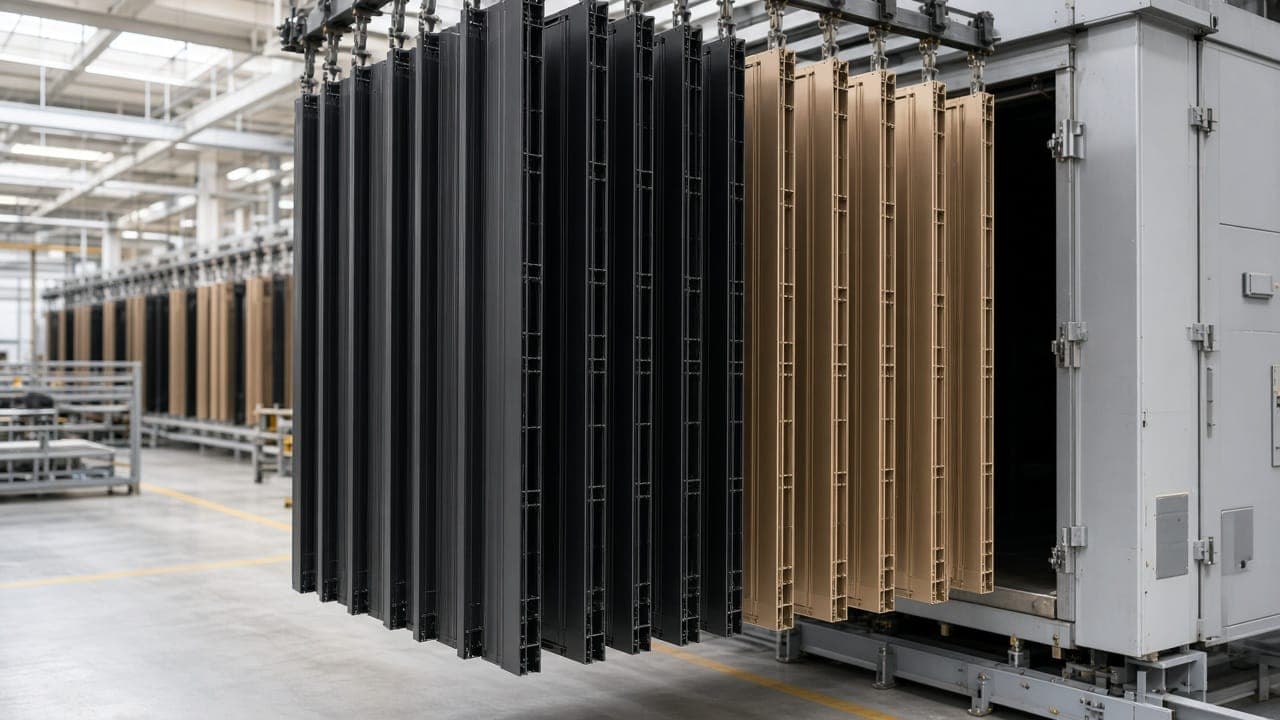
ARCVIEW's coating line holds Qualicoat China licence 1102 (record QC-1102-S-25, April 2025) for Class 2 super-durable powders with the Seaside pre-treatment, applied to all powder-coated profiles. The licence record lists a 2,000-hour salt spray result, a 3-year Florida test and a 15-year coating warranty. For Australian coastal sites and Gulf projects, we specify Seaside pre-treatment by default.
Matching the class to the site
Choose the class by UV exposure and the class of pre-treatment by corrosivity. Treat them as two separate decisions. Inland, low-UV sites with sheltered frames can justify Class 1, although most window specifiers now default to Class 2 because the cost difference is small compared with a repaint. High-UV climates such as Australia, the Gulf and the US Sun Belt fade standard polyesters visibly within a few years, so Class 2 is the practical minimum and Class 3 suits dark colours on landmark façades. Sites near the sea, near swimming pools or in industrial atmospheres need Seaside pre-treatment whatever the powder class, because filiform corrosion starts under the film at cut edges and fixings.
Qualicoat vs AAMA 2603, 2604 and 2605
| Specification | Florida exposure | Gloss retention | Colour change | Salt spray (approx.) | Nearest Qualicoat class |
|---|---|---|---|---|---|
| AAMA 2603 | 1 year | Limited requirements | Limited requirements | ≈ 1,500 h | Class 1 |
| AAMA 2604 | 5 years | ≥ 30% | ≤ 5 ΔE | ≈ 3,000 h | Class 2 |
| AAMA 2605 | 10 years | ≥ 50% | ≤ 5 ΔE | ≈ 4,000 h | Class 3 |
North American specifications usually name AAMA 2604 for residential and light commercial work and AAMA 2605 for commercial façades, which is often met with 70% PVDF liquid coatings. European, Middle Eastern and Australian specifications more often name Qualicoat, sometimes alongside GSB. If a specification names AAMA 2605, a Qualicoat Class 2 powder is not automatically accepted. Ask the consultant before substituting. Our finish comparison explains when anodising or PVDF is a better choice.
Warranty expectations
Qualicoat sets material and process requirements. It does not set warranty terms, which are commercial. Typical market practice is roughly 5–10 years for Class 1 exteriors, 10–25 years for Class 2 super-durables and longer terms for Class 3 and PVDF. Terms are usually conditional on location (coastal distance), cleaning frequency and correct installation. Read the exclusions. Most coating warranties exclude sites within a set distance of the sea unless Seaside pre-treatment was specified, and require cleaning at least once or twice a year. ARCVIEW's standard is 15 years on Qualicoat powder coating, alongside 10 years on frames and thermal breaks.
What to ask a supplier for
- The coater licence number, checked against the Qualicoat licensee list or the national general licensee.
- The powder product name and its Qualicoat approval in the class you are buying, with the colour code (for example RAL 7016 fine texture).
- Confirmation of the pre-treatment: chrome or chrome-free, etch rate, and whether the Seaside label applies to your order.
- Batch QC records: film thickness readings, cross-cut adhesion, gloss and curing records for your production run.
- The warranty document with its exclusions, coastal-distance conditions and cleaning requirements.
- Retained colour samples or a signed master panel for future matching.
Specifications evolve, and Qualicoat publishes new editions with revised tests and limits. Confirm the current edition, and any local requirements, with your consultant or Qualicoat's national licensee before tender. Coating evidence for ARCVIEW profiles is on our certifications page, and you can request samples with your quote.
Frequently asked questions
- What is the difference between Qualicoat Class 1 and Class 2?
- Class 1 powders are standard-durability polyesters approved after 1 year of Florida exposure, with at least 50% gloss retention. Class 2 super-durable powders must pass 3 years of Florida exposure, retaining at least 90% gloss after 1 year, 75% after 2 years and 50% after 3 years, with tighter colour-change limits. Class 2 is the usual choice for exterior windows.
- What is Qualicoat Seaside?
- Seaside is an additional Qualicoat label for coating plants that apply an enhanced pre-treatment for aggressive environments, such as coastal, humid or polluted sites. It requires a deeper etch, typically at least 2 g/m² total, or pre-anodising before the conversion coat. This greatly improves resistance to filiform corrosion. It concerns pre-treatment, not powder durability, so it is combined with Class 1, 2 or 3 powders.
- Is Qualicoat Class 2 equivalent to AAMA 2604?
- They are broadly comparable super-durable tiers, but not formally equivalent. AAMA 2604 requires 5 years of Florida exposure with about 30% gloss retention and colour change within 5 ΔE units. Qualicoat Class 2 requires 3 years with 50% gloss retention, plus its own laboratory tests. If a contract names one specification, get written approval before substituting the other.
- How do I verify a supplier's Qualicoat licence?
- Ask for the coater licence number and check it against the licensee list published by Qualicoat or its national general licensee. Then ask for the Qualicoat approval of the specific powder and class used on your order. Both are needed: the licence covers the coating plant and its pre-treatment, and the approval covers the powder's durability class.
- How long should a powder coating warranty be?
- Qualicoat does not set warranty periods; they are commercial terms. Typical market practice is about 5–10 years for Class 1, 10–25 years for Class 2 super-durable powders, and longer for Class 3 or PVDF. Check the exclusions: coastal distance, required cleaning frequency and installation damage. ARCVIEW offers 15 years on Qualicoat powder coating.
Sources & standards
- 01Qualicoat specifications for a quality label for liquid and powder organic coatings on aluminium — Qualicoat
- 02AAMA 2603, 2604 and 2605 voluntary specifications for organic coatings on aluminium — Fenestration and Glazing Industry Alliance (FGIA)
- 03ISO 9227 corrosion tests in artificial atmospheres: salt spray tests — International Organization for Standardization (ISO)
- 04Qualanod quality label for anodising (for comparison with organic coatings) — Qualanod