Key takeaways
- U-value measures heat loss in W/m²K, and the US U-factor measures the same thing in Btu/h·ft²·°F; multiply the U-factor by 5.678 to convert, so U-0.30 equals about 1.70 W/m²K.
- Compare windows on whole-window Uw, which combines glass (Ug), frame (Uf) and the spacer edge (psi-g), never on centre-of-glass Ug alone.
- The same aluminium window design can change by about 0.4 W/m²K between a 0.6 × 0.9 m and a 2.4 × 2.4 m unit, because the frame share and spacer length change with size.
- SHGC (NFRC) is a whole-window value, while the European g-value is usually quoted for the glass only, so a window SHGC is normally lower than the g-value of its glass.
- Passive House cool-temperate components require Uw ≤ 0.80 W/m²K at standard size and about 0.85 W/m²K installed.
U-value is the rate of heat loss through a window per square metre per degree of temperature difference, in W/m²K. The North American U-factor is the same quantity in Btu/h·ft²·°F; multiply by 5.678 to convert. SHGC (solar heat gain coefficient) and the European g-value both measure the fraction of solar energy that passes through. SHGC is normally a whole-window figure and g usually refers to the glass only, so the two are not directly interchangeable.
The components: Uw, Ug, Uf and psi-g
Under EN ISO 10077-1, the whole-window value is an area-weighted sum: Uw = (Ag·Ug + Af·Uf + lg·ψg) / (Ag + Af). Ug is the centre-of-glass value from EN 673. Uf is the frame value, calculated by 2-D simulation to EN ISO 10077-2. ψg (psi-g) is the linear thermal transmittance of the glass edge and spacer in W/mK, and lg is the visible glass perimeter. Typical values are a ψg of about 0.03–0.05 W/mK for a warm-edge spacer against roughly 0.07–0.09 W/mK for an aluminium spacer, and a Uf of about 1.3–2.5 W/m²K for thermally broken aluminium depending on break width (see our thermal break guide).
| Term | Meaning | Unit | Standard |
|---|---|---|---|
| Uw | Whole-window thermal transmittance | W/m²K | EN ISO 10077-1 / -2 |
| Ug | Centre-of-glass thermal transmittance | W/m²K | EN 673 |
| Uf | Frame thermal transmittance | W/m²K | EN ISO 10077-2 |
| ψg (psi-g) | Glass-edge / spacer linear loss | W/mK | EN ISO 10077-2 |
| U-factor | Whole-product heat loss (North America) | Btu/h·ft²·°F | NFRC 100 |
| g-value | Total solar energy transmittance, usually glass only | 0–1 | EN 410 |
| SHGC | Solar heat gain coefficient, whole product | 0–1 | NFRC 200 |
| VT / τv | Visible (light) transmittance | 0–1 | NFRC 200 / EN 410 |
Why window size changes Uw
On a good window the frame and glass edge lose more heat per square metre than the centre of the glass. Small windows have proportionally more frame and edge, so their Uw is higher. The example below holds every component constant (Ug 0.6, Uf 1.6, ψg 0.04, 110 mm combined sightline on each side) and changes only the size.
| Size (W × H) | Window area | Glass share | Uw |
|---|---|---|---|
| 0.60 × 0.90 m | 0.54 m² | 48% | ≈ 1.28 W/m²K |
| 1.23 × 1.48 m (EN reference size) | 1.82 m² | 70% | ≈ 1.00 W/m²K |
| 2.40 × 2.40 m | 5.76 m² | 83% | ≈ 0.84 W/m²K |
This is why a quote that states only ‘Uw 1.0’ is incomplete. Ask at what size. EN declarations usually use the 1.23 × 1.48 m reference size. NFRC uses its own standard sizes per product type. Energy codes in the UK and elsewhere increasingly expect values for the actual sizes, or for a standard size defined in national guidance.
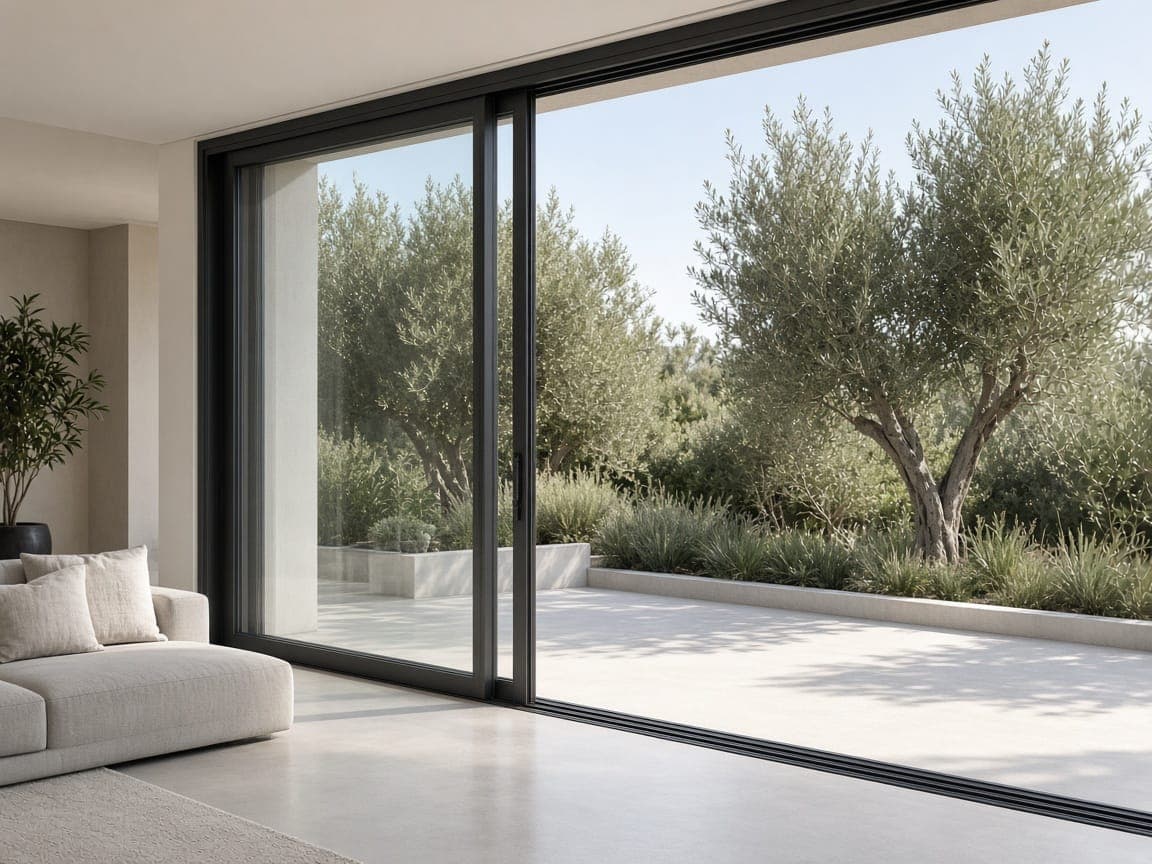
Sliding doors and curtain walls show the same effect in a different form. A lift-and-slide door with large panels has a high glass share, so a good IGU dominates its Uw. A multi-panel bi-fold has many vertical stiles, so its frame share and Ud are higher even with identical glass. When comparing system types, compare at the sizes you will actually build, not at each supplier's most flattering configuration.
SHGC, g-value and visible transmittance
A low-E solar-control glass might have a g-value of 0.28 at centre of glass. Because the opaque frame admits very little solar energy, the whole-window SHGC of the same unit could be closer to 0.22–0.25, depending on the frame share. In hot climates such as the Gulf, codes cap SHGC. ARCVIEW's Dubai hotel project used C80 casements with solar-control low-E glass to keep SHGC under 0.28. In cold climates, a moderate SHGC is often useful for passive solar gain. Visible transmittance (VT) should be checked alongside SHGC, because very dark glass can meet a solar limit at the cost of daylight.
European vs NFRC numbers for the same window
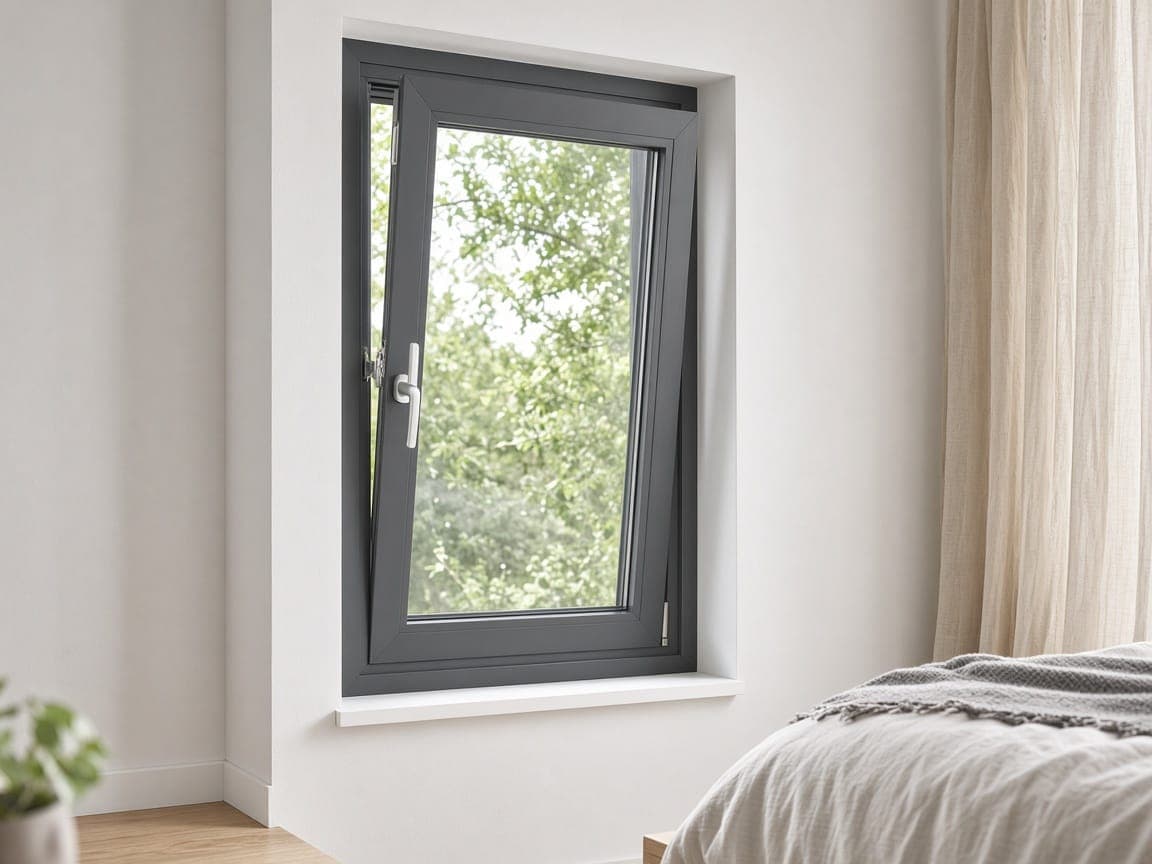
NFRC and EN methods use different boundary conditions, standard sizes and calculation rules. NFRC ratings for the same product usually come out somewhat worse than the EN Uw. For example, ARCVIEW's C80 tilt-turn has an EN Uw from 0.9 W/m²K and an NFRC-certified U-factor of 0.20 (about 1.14 W/m²K), with SHGC 0.27 and VT 0.48. Neither number is wrong. They answer the same question under different rules, which is why you cannot convert a European Uw into an NFRC label value. See our NFRC guide.
Typical requirements by region
| Region / scheme | Typical window requirement | Notes |
|---|---|---|
| England, Approved Document L (2021) | New dwellings: limiting Uw ≈ 1.6 W/m²K, notional ≈ 1.2; replacement windows ≈ 1.4 W/m²K | Wales and Scotland set their own values |
| Passive House (cool-temperate) | Uw ≤ 0.80 W/m²K at standard size; ≈ 0.85 W/m²K installed | Stricter in arctic zones, less strict in warm zones |
| US IECC residential (2021 basis) | U-factor ≈ 0.50 (zones 0–1) to ≈ 0.30 (zones 3–8); SHGC ≈ 0.25 in zones 0–3 | States adopt different editions and amendments |
| ENERGY STAR Northern zone (v7) | U-factor ≤ 0.22 (≈ 1.25 W/m²K) | Voluntary programme |
| Australia NCC 2022 | No single window value: NatHERS 7-star homes or Section J façade calculations using Uw and SHGCw | Uses AFRC-method ratings |
| Dubai Green Building Regulations | Solar control typically governs; SHGC caps apply to glazing | Limits vary with glazing ratio and orientation |
ARCVIEW's C80 tilt-turn is a certified Passive House component for cool-temperate climates (PHI certificate 1873wi03, efficiency class phB) with an installed Uw of 0.78 W/m²K, an fRsi of 0.73 and an installation psi of 0.019 W/mK. Details are on our certifications page.
How to compare quotes fairly
- Ask for whole-window Uw (or NFRC U-factor), not Ug. A quote that leads with ‘Ug 0.5’ often has a much higher Uw.
- Fix the reference size: either the EN 1.23 × 1.48 m size, or calculated values for your actual window schedule.
- Check the method and evidence: EN ISO 10077-2 frame simulation or EN ISO 12567-1 hot-box test from a notified or accredited laboratory, or an NFRC certified rating.
- Compare spacer type and ψg, gas fill (argon at about 90%) and the low-E coating position, because these drive the difference between offers.
- Compare SHGC or g on the same basis, whole window or glass only, and check VT alongside it.
- For high-performance buildings, ask for installed values, which include the installation psi.
For profile choice, see aluminium vs uPVC and double vs triple glazing. ARCVIEW's C80 casement reaches Uw from 0.9 W/m²K and the S120 lift-and-slide from 1.1 W/m²K at EN conditions.
Frequently asked questions
- How do I convert a U-factor to a U-value?
- Multiply the U-factor in Btu/h·ft²·°F by 5.678 to get W/m²K, or divide a U-value by 5.678 to get a U-factor. For example, U-factor 0.20 is about 1.14 W/m²K and 1.4 W/m²K is about 0.25. This converts units only; NFRC and EN ISO 10077 ratings use different conditions and sizes, so the results are not directly equivalent.
- What is a good U-value for an aluminium window?
- With a wide thermal break and double low-E argon glazing, a thermally broken aluminium window typically achieves a Uw of about 1.3–1.6 W/m²K at EN reference size. With triple glazing and an insulated frame, about 0.8–1.1 W/m²K is achievable. ARCVIEW's C80 reaches 0.9 W/m²K. What counts as good depends on the local code and climate.
- Is SHGC the same as g-value?
- They measure the same physical property, the fraction of incident solar energy transmitted indoors, but they are usually quoted on different bases. NFRC SHGC is a whole-window value including the frame. The EN 410 g-value on glass datasheets is normally centre-of-glass. A window's SHGC is therefore usually lower than its glass g-value. Confirm which basis your code limit uses.
- Why does my small window have a worse U-value?
- Frames and the glass-edge spacer lose more heat per square metre than the centre of high-performance glass. A small window has a larger share of frame and edge, so its whole-window Uw is higher. In a typical calculation, the same design can go from about 0.84 W/m²K at 2.4 × 2.4 m to about 1.28 W/m²K at 0.6 × 0.9 m.
- What U-value does Passive House require?
- For the cool-temperate climate zone, which covers most of Central Europe, the Passive House Institute requires a window Uw of 0.80 W/m²K or lower at the standard test size, and an installed value of about 0.85 W/m²K or lower including installation losses. Requirements are stricter in colder zones and less strict in warmer zones. Check the current criteria with PHI.
Sources & standards
- 01Passive House certified components: criteria for transparent building components — Passive House Institute
- 02NFRC 100 and NFRC 200 rating procedures — NFRC
- 03Conservation of fuel and power: Approved Document L — UK Government (GOV.UK)
- 04ENERGY STAR residential windows, doors and skylights — U.S. Environmental Protection Agency / ENERGY STAR
- 05National Construction Code energy efficiency provisions — Australian Building Codes Board
- 06International Energy Conservation Code — International Code Council