Key takeaways
- Thermally broken aluminium frames typically reach Uf 1.0–2.4 W/m²K and multi-chamber uPVC frames 1.0–1.6 W/m²K, so with the same glazing the whole-window U-value gap is usually under 0.3 W/m²K.
- Aluminium is roughly 25 times stiffer than uPVC (about 70 GPa vs 2.5–3 GPa), which is why it is the default for sliding and folding doors wider than about 3 m and for panels heavier than 300 kg.
- uPVC typically costs 20–40% less than thermally broken aluminium for standard-size windows, making it the better value for small openings in cold climates on a tight budget.
- Aluminium frames typically last 40–60 years against 25–35 years for uPVC, and uPVC expands about three times as much with temperature, so dark colours in hot sun favour aluminium.
- Recycling aluminium uses about 5% of the energy needed for primary metal, but frames made from primary billet carry higher embodied carbon, so ask for an EN 15804 EPD rather than assuming either material is greener.
Choose aluminium windows when you need large openings, slim sightlines, dark colours, high wind resistance or a frame life of 40 years or more. Choose uPVC when the priority is the lowest cost per window at a good U-value on standard sizes. Thermally broken aluminium now reaches frame U-values (Uf) of 1.0–2.4 W/m²K, against 1.0–1.6 W/m²K for multi-chamber uPVC. The thermal gap is small enough that cost, opening size and durability usually decide.
This guide compares the two materials property by property, using figures typical of mid- to high-specification residential and light-commercial systems. Neither material is better everywhere, and the section on when uPVC wins is meant to be taken at face value.
Strength and stiffness: why aluminium spans further
The decisive difference is stiffness. 6063-T6 aluminium has a Young's modulus of about 70 GPa, while rigid uPVC sits around 2.5–3 GPa, so aluminium is roughly 25 times stiffer. uPVC sashes and frames above about 1.2–1.5 m usually need galvanised steel reinforcement in the main chamber to control deflection. That adds weight and cost and creates a thermal bridge inside the profile.
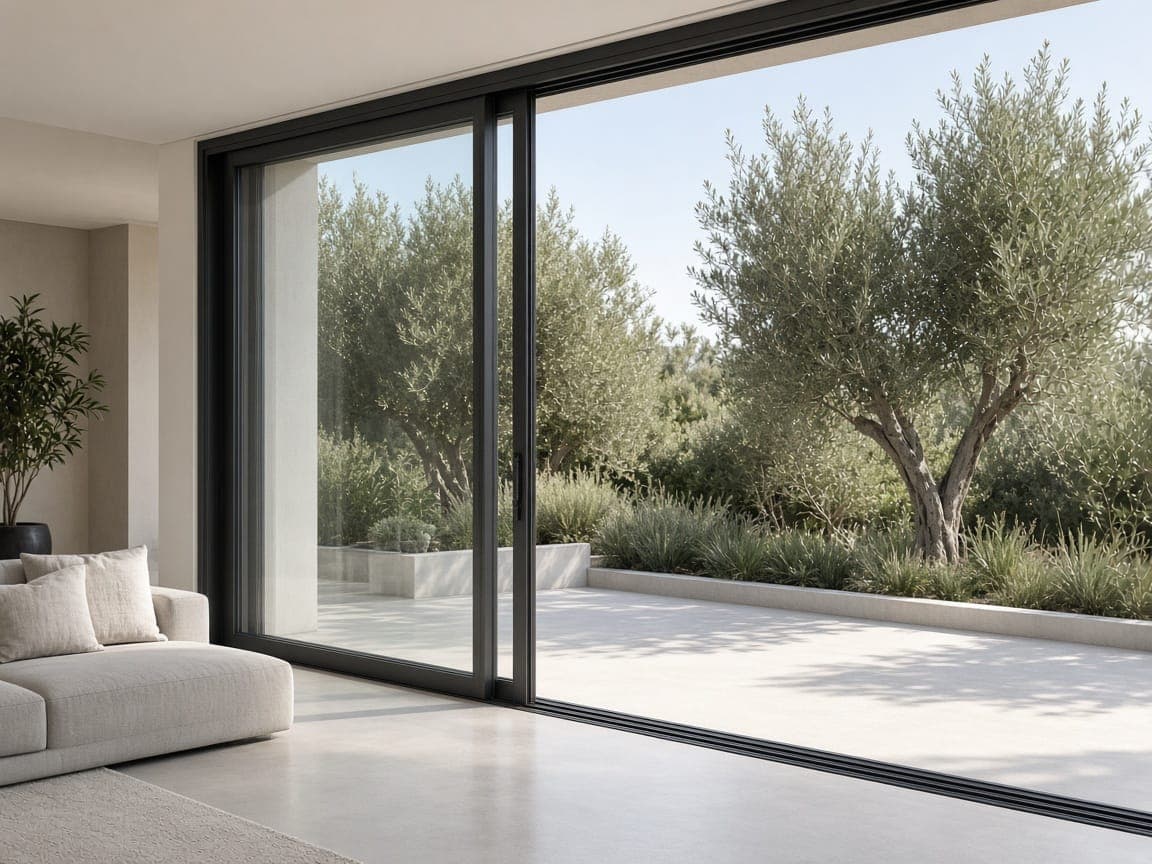
In practice this sets the size limits. A uPVC lift-and-slide sash typically tops out at 200–400 kg. Aluminium systems routinely carry 300–600 kg: our ARC-S90 / S120 lift & slide is rated to 600 kg and 3.2 × 3.6 m per panel and tested to 2,000 Pa (EN 12210 Class C5) wind load. Stiffness also shows up in the sightlines. A thermally broken aluminium casement typically shows 65–95 mm of combined frame and sash, against 105–130 mm for uPVC, so aluminium gives more glass in the same opening.
| Property | Thermally broken aluminium | uPVC (multi-chamber, steel-reinforced) |
|---|---|---|
| Stiffness (Young's modulus) | ≈ 70 GPa | ≈ 2.5–3 GPa; steel reinforcement needed on larger sashes |
| Linear thermal expansion | ≈ 23 × 10⁻⁶ /K | ≈ 70–80 × 10⁻⁶ /K |
| Frame U-value Uf | 1.0–2.4 W/m²K | 1.0–1.6 W/m²K |
| Frame + sash face width (casement) | 65–95 mm | 105–130 mm |
| Typical max sliding panel weight | 300–600 kg | 200–400 kg |
| Dark colours in strong sun | No restriction (powder, anodised, PVDF) | Restricted; heat-reflective foils needed, distortion risk |
| Typical frame service life | 40–60 years | 25–35 years |
| Fire behaviour of profile material | Non-combustible alloy; melts at ≈ 600–655 °C | Combustible; softens at ≈ 75–85 °C |
| Salt-air corrosion | Needs marine pre-treatment or anodising | Does not corrode; steel reinforcement must be galvanised |
| Relative price, standard window | ≈ 1.2–1.6× | 1.0× (baseline) |
Thermal performance: closer than most buyers think
Without a thermal break, an aluminium frame conducts heat at Uf ≈ 5.5–7 W/m²K and is unsuitable for heated buildings. With a polyamide thermal break of 24–34 mm and foam-filled chambers, aluminium closes most of the gap with uPVC. The details are in our guide to thermal-break aluminium. Glass is typically 65–80% of a window's area, so the glazing choice moves the whole-window Uw more than the frame material does.
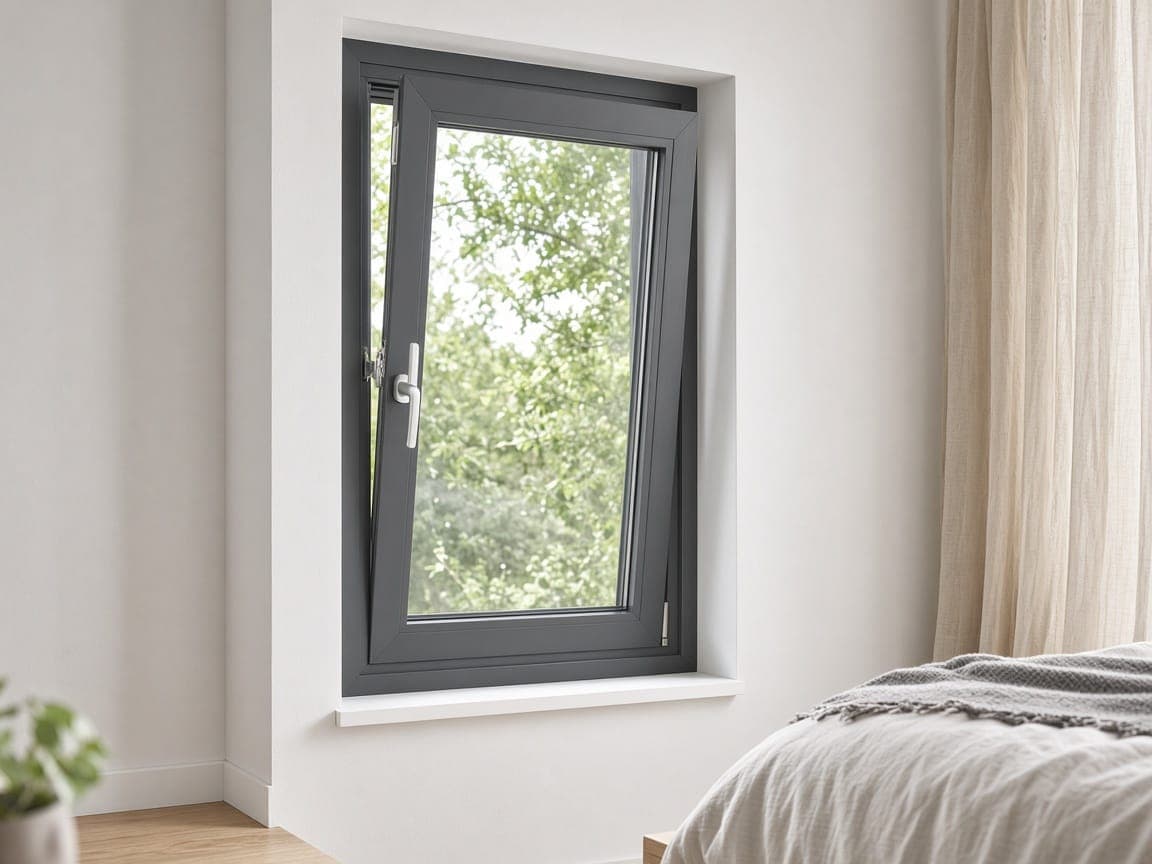
In concrete terms, our C80 tilt-turn reaches Uw 0.9 W/m²K with triple glazing and is certified as a Passive House component (phB, Uw installed 0.78 W/m²K). Good uPVC Passive House windows reach similar figures. The honest point is that at the same price point, uPVC usually gives the lower Uf. Matching the best uPVC with aluminium needs a wide thermal break and insulated chambers, and those cost money.
Lifespan, movement and colour stability
Aluminium does not soften, creep or become brittle with UV exposure. Frames commonly stay in service for 40–60 years, with gaskets replaced at around 15–25 years and hardware as it wears. uPVC frames typically last 25–35 years. Modern calcium-zinc stabilised formulations (lead stabilisers were phased out of European window profiles by 2015) resist yellowing far better than older white uPVC.
Thermal movement matters for large frames. A 2 m uPVC frame heating by 50 K grows by about 7.5 mm, while an aluminium frame grows about 2.3 mm. Dark uPVC surfaces in direct sun can exceed 60–70 °C, so many uPVC systems restrict dark colours or require heat-reflective foils. Aluminium accepts anthracite, black and bronze without restriction. See powder coating vs anodising vs PVDF for finish durability.
Cost: purchase price versus life-cycle cost
For standard windows around 1.2 × 1.2 m, uPVC typically costs 20–40% less than thermally broken aluminium of similar thermal performance. Above about 2.5–3 m wide the gap narrows or reverses, because uPVC needs heavy reinforcement and few uPVC systems are tested at those sizes. Over the life of the building the comparison also shifts. If a uPVC window costing 100 units lasts 30 years, it costs 3.3 units per year. An aluminium window costing 140 units and lasting 50 years costs 2.8 units per year.
For reference, our factory-direct casement and tilt-turn windows are quoted at roughly USD 150–220 per m² FOB before freight, duties and installation. Our landed cost guide shows how those items change the final comparison with a local supplier.
Sustainability and recycling
Aluminium can be recycled repeatedly without losing properties, and remelting uses about 5% of the energy needed for primary production. European Aluminium reports end-of-life collection rates for building aluminium above 90%. Primary aluminium, however, carries a high carbon footprint that depends heavily on the smelter's power source. We extrude from primary 6063 billet for consistent metallurgy, which means our profiles carry more embodied carbon than profiles with a high recycled content.
uPVC can also be reprocessed several times, and European recycling schemes feed post-consumer window uPVC back into new profile cores. Published embodied-carbon figures for the two materials overlap widely. The defensible approach is to compare product-specific Environmental Product Declarations (EN 15804) for the actual systems rather than relying on generic material claims.
Which material wins: decision table
| Scenario | Better choice | Main reason |
|---|---|---|
| Standard 1.2 × 1.2 m windows, cold climate, tight budget | uPVC | Lowest cost per unit of U-value; small spans need no extra stiffness |
| Sliding or folding doors wider than 3 m | Aluminium | uPVC panel weight and deflection limits |
| Anthracite or black frames in hot sun | Aluminium | uPVC distortion risk at high surface temperature |
| Coastal site within 1 km of the sea, minimal maintenance | uPVC, or anodised / Seaside-coated aluminium | uPVC cannot corrode; aluminium needs a marine-grade finish and regular washing |
| High-rise above ~10 storeys or design wind load above 2,000 Pa | Aluminium | Stiffness and tested structural performance |
| Passive House new build | Either | Both reach Uw ≈ 0.8 W/m²K with triple glazing |
| Façade where codes limit combustible materials | Aluminium | Non-combustible profile material |
| Social-housing retrofit with standard sizes | uPVC | Cost and short local supply chain |
When uPVC is the better choice
- Budget-driven housing with standard sizes: uPVC gives the most thermal performance per unit of cost for openings under about 1.5 m.
- Cold-climate retrofit with no special requirements: a local uPVC fabricator can usually supply Uw 1.0–1.2 W/m²K quickly and without import logistics.
- Exposed marine sites where nobody will wash the frames: uPVC does not corrode, while aluminium relies on its finish and on maintenance.
- Projects where white or light colours are acceptable and sightlines are not part of the design intent.
If you have drawings and want a material recommendation based on your climate zone and budget, send them for an engineering review.
Frequently asked questions
- Are aluminium windows less energy efficient than uPVC?
- Not necessarily. Non-thermally-broken aluminium (Uf ≈ 5.5–7 W/m²K) is far worse than uPVC, but thermally broken aluminium reaches Uf 1.0–2.4 W/m²K against 1.0–1.6 W/m²K for uPVC. With the same Low-E double or triple glazing, the whole-window Uw difference is usually under 0.3 W/m²K, and premium aluminium systems reach Passive House levels around Uw 0.8 W/m²K.
- How long do aluminium and uPVC windows last?
- Thermally broken aluminium frames typically last 40–60 years because the metal does not soften, creep or degrade under UV. uPVC frames typically last 25–35 years, depending on formulation, colour and sun exposure. In both cases, gaskets usually need replacing after about 15–25 years and hardware needs periodic adjustment, so frame life depends on basic maintenance being carried out.
- Is uPVC cheaper than aluminium?
- For standard window sizes, yes. uPVC typically costs 20–40% less than thermally broken aluminium with similar thermal performance. The gap narrows or reverses for doors wider than about 2.5–3 m, for dark colours and for high wind loads, where uPVC needs heavy steel reinforcement or is not tested. Over a 50-year horizon, the longer life of aluminium can also offset its higher initial cost.
- Which is better near the sea, aluminium or uPVC?
- uPVC cannot corrode, so it is the lower-risk choice where frames will not be maintained. Aluminium performs well on coastal sites if it has a marine-grade finish, such as Qualicoat Seaside pre-treatment with super-durable powder or AA20–AA25 anodising, plus stainless 316 fixings. It also needs fresh-water washing every three to six months. Without that maintenance, coating warranties are usually void.
- Can uPVC windows be made in dark colours?
- Yes, usually with foils or coatings, but dark uPVC absorbs heat and surfaces can exceed 60–70 °C in strong sun. At those temperatures uPVC expands about three times as much as aluminium and can distort. Many manufacturers therefore limit dark colours or sizes or require heat-reflective foils. Aluminium accepts anthracite, black and bronze finishes without size restrictions.
Sources & standards
- 01Aluminium in buildings: recycling and sustainability — European Aluminium
- 02ISO 10077-2: Thermal performance of windows, doors and shutters — Calculation of thermal transmittance — Numerical method for frames — International Organization for Standardization (ISO)
- 03Certified Passive House components database and window criteria — Passive House Institute
- 04Update or Replace Windows — U.S. Department of Energy — Energy Saver
- 05Building materials, durability and environmental assessment research — BRE Group